segunda-feira, 14 de maio de 2012

The 70's

Society – Environmentalism
The 1970s started a mainstream affirmation of the environmental issues early activists from the 1960s, such as Rachel Carson and Murray Bookchin had warned of. The moon landing that had occurred at the end of the previous decade transmitted back concrete images of the Earth as an integrated, life-supporting system and shaped a public willingness to preserve nature. On April 22, 1970, the United States celebrated its first Earth Day in which over two thousand colleges and universities and roughly ten thousand primary and secondary schools participated.


Politics – Munich Massacre
The Munich Massacre was a terrorist attack during the 1972 Olympic Games. Eight Palestinian terrorists killed two members of the Israeli Olympic team and then took nine others hostage. The situation was ended by a huge gunfight that left five of the terrorists and all of the nine hostages dead. Following the massacre, the Israeli government organized a retaliation against Black September, called Operation Wrath of God.


Movies – Superman
Superman is a 1978 superhero film based on the DC Comics character of the same name. Richard Donner directed the film, which stars Christopher Reeve as Superman, as well as Marlon Brando. The film depicts the origin of Superman, including his infancy as Kal-El of Krypton and his youthful years in the rural town of Smallville. Disguised as reporter Clark Kent, he adopts a mild-mannered attitude in Metropolis and develops a romance with Lois Lane, while battling the villainous Lex Luthor.
The film was conceived in 1973 by Ilya Salkind. Several directors, most notably, and screenwriters associated with the project before Donner was hired to direct. Donner brought Tom Mankiewicz to rewrite the script, feeling it was too campy. Mankiewicz was credited as creative consultant. It was decided to film both Superman and Superman II simultaneously.
Tensions rose between Donner and the producers, and a decision was made to stop filming Superman II and finish the first film. Donner had already shot 75% of the planned sequel, eventually giving birth to Superman II: The Richard Donner Cut. Superman was released with critical acclaim and financial success. Reviewers noted parallels between the film's depiction of Superman and Jesus and particularly praised Reeve's performance. The film's legacy helped to foster the establishment of the superhero film genre.


Music - Aerosmith
Aerosmith is an American rock band, even if they are known as a Boston, Massachusetts band, none of the members are from the city, three of the members Steven Tyler, Joe Perry and Tom Hamilton had originally met in Sunapee New Hampshire in the late 60's, but had not yet formed a band with Tyler was from Yonkers, New York, Perry from Hopedale, Mass., and Hamilton from New London, New Hampshire In 1970, the three decided that they would form a band together and to Boston Massachusetts is the place to do it later they met up with Joey Kramer (drums) and Brad Whitford (guitar)
The band had great popularity in the 1970s with rock anthems like "Dream On" - but they shared the 1979-84 due to severe abuse and drugs.

The 70's

Music

The early 1970s saw the rise of popular soft rock/pop rock music. Led Zeppelin was an English rock band, active in the late 1960s and throughout the 1970s. They are widely considered to be one of the most successful, innovative and influential rock groups in the history of music. Led Zeppelin is one of the best-selling music artists—various sources estimate the group's sales at more than 200 or 300 million albums worldwide.


Movies

The Godfather is a 1972 American epic crime film directed by Francis Ford Coppola. Based on Puzo's 1969 novel of the same name, the film stars Marlon Brando and Al Pacino as the leaders of a powerful New York crime family. The Godfather is widely regarded as one of the greatest films in world cinema – and as one of the most influential, especially in the gangster genre. The film's success spawned two sequels: The Godfather Part II in 1974 and The Godfather Part III in 1990. It won three Oscars in 1972: for Best Picture, for Best Actor (Brando) and in the category Best Adapted Screenplay for Puzo and Coppola.


Society

Fiction in the early '70s brought a return to old-fashioned storytelling, especially with Erich Segal's. He was an American author, screenwriter, and educator. He was best known for writing the novel Love Story (1970), a best-seller, and writing the motion picture of the same name, which was a major hit. In 1967, from the story by Lee Minoff, he wrote the screenplay for The Beatles' 1968 motion picture, Yellow Submarine.


Politics

Margaret Hilda Thatcher is a British politician and the longest-serving (1979–1990) British prime minister of the 20th century, and the only woman ever to have held the post. A Soviet journalist nicknamed her the "Iron Lady", which later became associated with her uncompromising politics and leadership style. As prime minister, she implemented conservative policies that have come to be known as Thatcherism.

segunda-feira, 23 de abril de 2012

The 60's

·         Politics
The Bay of Pigs Invasion was an unsuccessful attempt by United States-backed Cuban exiles to overthrow the government of the Cuban dictator Fidel Castro. Increasing friction between the U.S. government and Castro's leftist regime led President Dwight D. Eisenhower to break off diplomatic relations with Cuba in January 1961. Even before that, however, the Central Intelligence Agency had been training anti-revolutionary Cuban exiles for a possible invasion of the island. The invasion plan was approved by Eisenhower's successor, John F. Kennedy.
On April 17, 1961 about 1300 exiles, armed with U.S. weapons, landed at the Bahía de Cochinos (Bay of Pigs) on the southern coast of Cuba. Hoping to find support from the local population, they intended to cross the island to Havana. It was evident from the first hours of fighting, however, that the exiles were likely to lose. President Kennedy had the option of using the U.S. Air Force against the Cubans but decided against it. Consequently, the invasion was stopped by Castro's army. By the time the fighting ended on April 19, 90 exiles had been killed and the rest had been taken as prisoners.
The failure of the invasion seriously embarrassed the young Kennedy administration. Some critics blamed Kennedy for not giving it adequate support and others for allowing it to take place at all. The captured exiles were later ransomed by private groups in the U.S.


·         Society

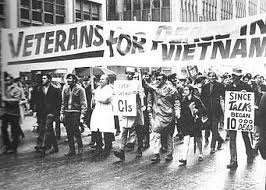
Anti-war movement - The war in Vietnam would eventually lead to a commitment of over half a million American troops, resulting in over 58,500 American deaths and producing a large-scale antiwar movement in the United States. As late as the end of 1965, few Americans protested the American involvement in Vietnam, but as the war dragged on and the body count continued to climb, civil unrest escalated. Students became a powerful and disruptive force and university campuses sparked a national debate over the war. As the movement's ideals spread beyond college campuses, doubts about the war also began to appear within the administration itself. A mass movement began rising in opposition to the Vietnam War, ending in the massive Moratorium protests in 1969, as well as the movement of resistance to conscription ("the Draft") for the war.


·         cinema


Planet of the Apes - In the year 3978A.D. a spaceship with a crew of 4, crashes down on a distant planet. One of the crew members had died in space and the other 3 head out to explore the planet. They soon learn that the planet is much like their own. They then find the planet is inhabited by intelligent apes. One of the men is shot and killed and the others are taken to the apes' city. There, one undergoes brain surgery and is put into a state of living death. The other befriends some of the apes but is feared by most. After being put through ape trial he escapes with a female human native to the planet. After helping his ape friends escape a religious heresy trial he escapes out into the winess with the female. There he learns the planet might not be so distant after all...


·         Music

The British Invasion occurred in the mid-'60s, when a wave of English rock & roll bands crossed over into the American market after the breakthrough success of the Beatles. Though not all of the bands sounded similar -- they ranged from the hard rock of the Rolling Stones and the Kinks to the sweet pop of Gerry & the Pacemakers and Herman's Hermits -- each group was heavily influenced by American rock & roll, blues, and R&B. British Invasion bands were either blues-based rockers or pop/rockers with ringing guitars and catchy hooks & melodies. Between 1964 and 1966, the British bands dominated the American charts, as well as the charts in the U.K. In that time, there was a second wave of British Invasion bands -- such as the Who and the Zombies -- which was indebted to both American rock and British Invasion pop. By the late '60s, many of the bands had become rock icons but a greater number didn't survive the transition into the post-Sgt. Pepper era.

The 50's


Politics
Korean War (1950–1953) – The war, which lasted from June 25, 1950 until the signing of the Korea Armistice Agreement on July 27, 1953, started as a civil war between North Korea and the Republic of Korea (South Korea). When it began, North and South Korea existed as provisional governments competing for control over the Korean peninsula, due to the division of Korea by outside powers. While originally a civil war, it quickly escalated into a war between the western powers under the United Nations Command led by the United States and its allies and the communist powers of the People's Republic of China and the Soviet Union. The North Korean army collapsed, and within a few days, MacArthur's army retook Seoul (South Korea's capital). He then pushed north, capturing Pyongyang in October. Chinese intervention the following month drove UN forces south again.


Music
The American folk music revival became a phenomenon in the United States in the 1950s to mid-1960s with the initial success of the Weavers who popularized the genre. Their sound, and their broad repertoire of traditional folk material and topical songs inspired other groups such as the Kingston Trio, the Chad Mitchell Trio, The New Christy Minstrels, and the "collegiate folk" groups such as The Brothers Four, The Four Freshmen, The Four Preps, and The Highwaymen. All featured tight vocal harmonies and a repertoire at least initially rooted in folk music and topical songs.

Cinema

The Thing from Another World (1951)
The first SciFi horror movie about an alien spacecraft discovered buried in the Arctic. After recovering the occupant the arctic base is victim to The Thing's terror. The film reveals only glimpses of The Thing riveting audiences in suspense. Directed by Howard Hawks and Christian Nyby released through RKO Radio Pictures Inc. "The Thing" is a precursor to "Alien" and future SciFi horror movies.
Society

The 1950's were a time of revolution for the social culture of the United States. Certain ideals and stereotypes were  dropped as well as the introduction of new forms of Art and Expression. Rock Music came into popularity with the new artists of the time and Technology surfaced to become a part of American Culture.
Teenagers started their own culteral and social category among American Citizens. Eager to excercise their freedom and values, they would test the boundaries of sexuality and consumerism. The explosive economy of the 1950's gave way for the Teenagers of the 1950's to spend like no other generation before it. Teenagers began to flout authroity and challenge the social environment. They were not trusted by the majority of their parents who believed they had it "easy" after the war.

The 60's


Music

The break between the music of the 1950s and the 1960s is imprecise. A reasonable way of "dating" the 1960s is with the "British invasion" of American music. This refers to the numerous British groups, admirers and emulators of American rock and roll, who broke into the U.S. market during the early 1960s.

The Beatles made their American debut on The Ed Sullivan Show on Sunday, February 9, 1964 (at 8 PM Eastern Time). In New York City, there were 50,000 requests for seats in the studio that held only 703 people. An estimated audience of 73 million television viewers watched the Beatles perform 5 songs and become the music rage of the United States.


Movies

Psycho  is a 1960 American suspense/horror film directed by Alfred Hitchcock and starring Anthony Perkins, Vera Miles, John Gavin, and Janet Leigh. The screenplay by Joseph Stefano is based on the 1959 novel of the same name by Robert Bloch. The novel was loosely inspired by the crimes of Wisconsin murderer and grave robber Ed Gein, who lived just 40 miles from Bloch. 


Politics

Counterculture/social revolution: In the second half of the decade, young people began to revolt against the conservative norms of the time, as well as remove themselves from mainstream liberalism, in particular the high level of materialism which was so common during the era. This created a "counterculture" that sparked a social revolution throughout much of the western world. The youth involved in the popular social aspects of the movement became known as hippies. These groups created a movement toward liberation in society, including the sexual revolution, questioning authority and government, and demanding more freedoms and rights for women and minorities. The movement was also marked by the first widespread, socially accepted drug use (including LSD and marijuana) and psychedelic music.


Society

On July 20, 1969, Apollo 11, the first human spaceflight landed on the Moon. Launched on July 16, 1969, it carried mission Commander Neil Armstrong, Command Module Pilot Michael Collins, and Lunar Module Pilot Buzz Aldrin. Apollo 11 fulfilled President John F. Kennedy's goal of reaching the moon by the end of the 1960s, which he had expressed during a speech given before a joint session of Congress on May 25, 1961: "I believe that this nation should commit itself to achieving the goal, before this decade is out, of landing a man on the Moon and returning him safely to the Earth."


segunda-feira, 16 de abril de 2012

The 50's

·         Society
The Hula Hoop was the most popular toy ever made. It is a brightly colored hoop made of plastic which is rotated around the body by moving your hips. This toy was introduced by Wham-O Manufaturing in 1958. It was very popular and stores kept running out. In the first six months 20 million were sold. In 1958, 100 million were sold worldwide. All around, people held Hula Hoop contests to see who could spin the longest. The Hula Hoop existed in Ancient Egypt, Greece, and Rome, and in the 14th century in England. Of course they didn't have plastic then. They got the name Hula Hoop from Hawaii because of the Hula Dancers. Wham-O Manufactured 20,000 hoops a day because of the popularity. The plastic tubing used for all Hula Hop ever produced would stretch around the earth more than 5 times.


         ·         Music
Johnny Cash defined the Country and Western style of music during this decade. Cash’s music was more of a country sound with a rockabilly influence and his songs often centered around a certain theme, including life, sorrow, and relationships. He also strived to integrate humor into his lyrics to make his collection well-rounded and respected by a variety of audiences. Because of his compassion for his fellow human being, he performed many times for inmates in several prisons across the country and his most famous performances resulted from Folsom Prison.
·         Cinema
As the popularity of television grew in the early 1950’s the motion picture industry found itself losing customers. To regain viewers movie executives began trying new and different things, pne of these was the release of 3-D movies.
The first 3-D film during the decade was Bwana Devil, Premiering in November of 1952, while the movie itself was not very good, some of the 3-D effects were.
Over the next couple of years many more movies were released in 3-D, among these were 3-D versions of House of Wax, Hondo, Dial M For Murder and Kiss Me Kate.
However, the 3-D fad didn’t last. Some viewers suffered eyestrain and headaches from watching 3-D films. In addition, if the projection wasn’t done perfectly by the theater the film was just a blurred mess. As a result, the regular version of a film often had more viewers than the 3-D version.
movie part in 3-D require anaglyph 3-D glasses

 
·         Politics
During the 1950's, an organization called the European Coal and Steel Community was formed between six Western European countries. This was established, and became protocol with the Treaty of Paris which was signed in April of 1951, and became effective on July 25, 1952.
The attempt to pool steel and coal resources through the Treaty of Paris in an effort to rebuild post-war Europe is considered the first step in the creation of the modern day European Union which now includes 27 member-states.

The 50's

Music
Rock and roll dominated popular music in the latter half of the 1950s. The musical style originated and evolved in the United States during the late 1940s and early 1950s, and quickly spread to much of the rest of the world. Elvis Presley was one of the most popular American singers of the 20th century. He is often referred to as the "King of Rock and Roll" or simply "the King". 


Politics
This is a picture of one of the presidents during the 1950's. His name is Dwight D. Eisenhower, also known as Ike. He became our president in 1952. He was well known for being the Supreme commander of the Allied Forces in Europe, which was during World War II. When he became the president his slogan was "We Like Ike". He helped the department of Education and the Department of Welfare. During his presidency some people criticized the way he handled school segregation. They said that he went too slow, but the one thing that was good about him was that he stood for the Civil Rights Act in 1957. Eisenhower was a republican and he was elected twice, once in 1952 and again in 1956. His election in 1952 was the first to ever be broadcast on television. Also CBS used one of the first computers to ever predict the election.  


Cinema
When Worlds Collide (1951)
Produced by George Pal based on the SciFi novel by Philip Gordon Wylie and Edwin Balmer. One of the earlier doomsday movies about Earth getting hit by another planet. Filmed in Technicolor, directed by Rudolph Maté and winner of the 1951 Academy Award for special effects. Inspiration for the movie "Deep Impact".


Society
Pop Art used the iconography of television, photography, comics, cinema and advertising. With its roots in dadaism, it started to take form towards the end of the 1950s when some European artists started to make the symbols and products of the world of advertising and propaganda the main subject of their artistic work. This return of figurative art, in opposition to the abstract expressionism that dominated the aesthetic scene since the end of World War II was dominated by Great Britain until the early 1960s when Andy Warhol, the most known artist of this movement began to show Pop Art in galleries in the United States.